Greek Mythology in Art
  • Home
  • Artists
    • Jan Cossiers
    • Herbert James Draper
    • Jacob Jordaens
    • Peter Paul Rubens
    • Johann Heinrich Tischbein the Elder
    • Titian
    • John William Waterhouse
  • Museums
    • The National Gallery >
      • Artemis and Callisto (Titian)
      • Judgement of Paris (Rubens)
      • Leda and the Swan (After Michelangelo)
      • Death of Actaeon (Titian)
      • Pan and Syrinx (Boucher)
      • Diana and Callisto (Bril)
      • Bacchus and Ariadne (Titian)
    • Prado >
      • Meleager and Atalanta (Jordaens)
      • The Three Graces (Rubens)
      • Deucalion and Pyrrha (Rubens)
      • Sisyphus (Titian)
      • Punishment of Tythus (Titian)
      • Briseis given back to Achilles by Nestor (Rubens)
      • Narcissus (Cossiers)
      • Cadmus and Minerva (Jordaens)
      • Prometheus Carrying Fire (Cossiers)
      • Jupiter and Lycaon (Cossiers)
      • Orpheus and Eurydice (Rubens)
      • The Fall of Icarus (Gowy)
    • Musee d'Orsay >
      • Sarpedon (Levy)
    • The Louvre >
      • The Three Graces (Regnault)
      • The Abduction of Ganymede by Zeus (Le Sueur)
      • The Race between Hippomenes and Atalanta (Halle)
      • Ixion, King of the Lapiths, Deceived by Juno, Who He Wished to Seduce (Rubens)
      • Phaedra and Hippolytus (Guerin)
    • The Hermitage >
      • Feast of the Gods (Rottenhammer)
      • The Three Graces (Furini)
      • Helen Recognising Telemachus (Lagrenee)
  • Subjects
    • The Three Graces
    • Ganymede
    • Hylas and the Nymphs
    • Glaucus and Scylla
    • Prometheus
  • Index
  • Buy me a Coffee

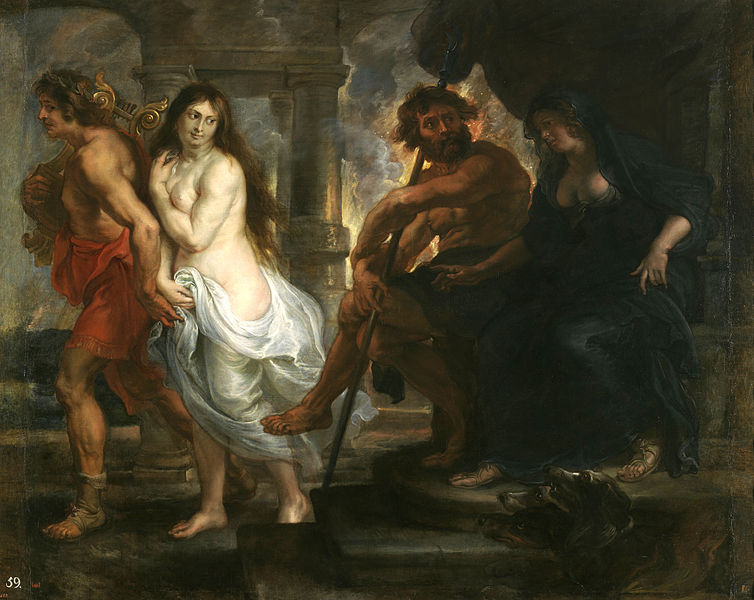
Orpheus and Eurydice
Orpheus Underworld
Orpheus and Eurydice - Peter Paul Rubens (1577–1640) - Prado Museum
Orpheus and Eurydice - Peter Paul Rubens (1577–1640) - Prado Museum​
Date: 1636-38
Medium: Oil on canvas
Dimensions: 196.5 x 247.5 cm
Peter Paul Rubens painted Orpheus and Eurydice, as an oil on canvas composition,  between 1636 and 1638, and depicts an event spoken of in Greek mythology.

Orpheus was a legendary hero who had married the beautiful Eurydice. Eurydice though was killed by a poisonous snake and was taken to the Underworld.

Orpheus would descend to the realm of Hades, and play his lyre with such skill and beauty that Persephone persuaded Hades to release Eurydice. The journey to the upper world went smoothly until Orpheus prematurely looked back for his wife, and as a consequence Eurydice was lost to him once again. 

More information about Orpheus can be found here - 
(website opens in new window)

Peter Paul Rubens

Born: 28 June 1577; Siegen, Germany
Died: 30 May 1640; Antwerp, Belgium
Nationality: Flemish
Art Movement: Baroque
Painting School: Flemish School, Antwerp School​​​​

Other Paintings of Orpheus

.

.

.

Copyright © 2018-2024
  • Home
  • Artists
    • Jan Cossiers
    • Herbert James Draper
    • Jacob Jordaens
    • Peter Paul Rubens
    • Johann Heinrich Tischbein the Elder
    • Titian
    • John William Waterhouse
  • Museums
    • The National Gallery >
      • Artemis and Callisto (Titian)
      • Judgement of Paris (Rubens)
      • Leda and the Swan (After Michelangelo)
      • Death of Actaeon (Titian)
      • Pan and Syrinx (Boucher)
      • Diana and Callisto (Bril)
      • Bacchus and Ariadne (Titian)
    • Prado >
      • Meleager and Atalanta (Jordaens)
      • The Three Graces (Rubens)
      • Deucalion and Pyrrha (Rubens)
      • Sisyphus (Titian)
      • Punishment of Tythus (Titian)
      • Briseis given back to Achilles by Nestor (Rubens)
      • Narcissus (Cossiers)
      • Cadmus and Minerva (Jordaens)
      • Prometheus Carrying Fire (Cossiers)
      • Jupiter and Lycaon (Cossiers)
      • Orpheus and Eurydice (Rubens)
      • The Fall of Icarus (Gowy)
    • Musee d'Orsay >
      • Sarpedon (Levy)
    • The Louvre >
      • The Three Graces (Regnault)
      • The Abduction of Ganymede by Zeus (Le Sueur)
      • The Race between Hippomenes and Atalanta (Halle)
      • Ixion, King of the Lapiths, Deceived by Juno, Who He Wished to Seduce (Rubens)
      • Phaedra and Hippolytus (Guerin)
    • The Hermitage >
      • Feast of the Gods (Rottenhammer)
      • The Three Graces (Furini)
      • Helen Recognising Telemachus (Lagrenee)
  • Subjects
    • The Three Graces
    • Ganymede
    • Hylas and the Nymphs
    • Glaucus and Scylla
    • Prometheus
  • Index
  • Buy me a Coffee